
The Modern AI Product Manager: Thriving in the Age of Agents
When I joined Google three months ago, I witnessed what felt like three years’ worth of AI progress: Gemini 3 Pro and Flash, the Interactions API, Nano Banana Pro, the Gemini Deep Research Agent, Antigravity Agentic IDE, the Gemini Live API with Native Audio, and ADKs for Python, Java, Go, and TypeScript with state-of-the-art context handling. This unprecedented acceleration isn’t unique to Google—every major and emerging AI company is shipping at breakneck speed, thanks to AI coding agents.
This revolution isn’t just changing technology—it’s fundamentally transforming product management. The traditional role of the product manager as a translator between customers and engineers is rapidly disappearing. In its place emerges a new paradigm where PMs must master the art of shaping problems clearly enough for AI agents to solve them directly.
The Disappearing Translation Layer
For decades, the product manager’s value lay in translation. You spoke with customers, synthesized their problems, wrote detailed specifications, and handed them to engineering teams. You served as the critical bridge between “what people need” and “what gets built.”
That translation layer is now compressing dramatically.

When AI agents can take a well-formed problem and produce working code, the PM’s job fundamentally shifts. You’re no longer translating for engineers—you’re forming intent with such clarity that agents can act on it directly. The specification document is becoming the product itself.
I’ve witnessed this transformation firsthand with dozens of product managers. Previously, the workflow looked like this: write detailed specs, hand them off, wait for questions, clarify requirements, wait for implementation, review results, provide feedback, and iterate. This cycle typically took weeks.
Today’s reality is different: write a clear problem statement with constraints, point an AI agent at it, and review working code within an hour.
The time between “I know what we should build” and “here it is” has collapsed dramatically. But the work of knowing what to build hasn’t become easier—it has become more important than ever.
You don’t need to write the code yourself, but you must understand what you want with such precision that an AI agent can build it accurately. Specifications and prototypes are merging into the same artifact. You describe what you want, watch it materialize, make course corrections, and iterate. Implementation is no longer the bottleneck.
The New PM Skillset: What Matters in the Age of Agents
Problem Shaping: The Core Competency
The best product managers have always excelled at problem shaping, but it was merely one skill among many. Today, it has become THE essential skill. Can you transform an ambiguous customer pain point into a clearly bounded problem that an AI agent (or team of agents) can solve effectively? Can you identify which constraints truly matter? Can you articulate precisely what success looks like?
In this new paradigm, your specification isn’t a document—it’s a well-formed problem with clearly defined boundaries.
Context Curation: The Invisible Superpower
This is the skill nobody discusses, yet every effective AI-era PM has developed it instinctively. The quality of an AI agent’s output is directly proportional to the context you provide.
When I first worked with agents, I gave vague prompts like “build me a customer feedback dashboard.” The results were technically functional but completely missed the mark. The agent lacked understanding of our users, constraints, and what “good” looked like for us.
Now, I maintain comprehensive context documents that I feed to agents before starting any project. Through trial and error, I’ve discovered what truly matters in these documents:
-
The specific user: Not a persona, but real details—who they are, what they care about, what makes them abandon a process, what captures their attention -
The problem in their own words: Direct quotes from customer calls, support tickets, or sales notes using their language, not your interpretation -
Examples of excellence: Concrete examples your team considers well-designed—your past work, competitors’ products, or adjacent solutions -
Failed attempts and why: Institutional knowledge that typically lives only in people’s heads—the approaches you’ve already discarded and the reasons why -
Solution-shaping constraints: Not every limitation, just those that will genuinely influence what gets built -
Success metrics: Concrete, measurable outcomes—not vague aspirations
When I now ask an agent to prototype something, it doesn’t start from zero. It understands who we’re building for, what users actually said, what good looks like, and what approaches have already failed. The output aligns because the input was specific and contextualized.
Evaluation and Taste: The Quality Filter
Taste is chronically undervalued in product development. But when AI agents produce output quickly and in volume, evaluation skills become paramount. Does this solution actually address the core problem? Does it handle the edge cases that truly matter? Is this ready to ship, or merely functional?
This is more challenging than it appears. AI agents confidently produce outputs that look correct but miss the mark entirely. Developing this taste requires deliberate practice.
There’s no shortcut: you must build things, evaluate them critically, and learn to distinguish between “technically works” and “good enough to ship.” This discernment comes only through experience.
The Mental Model Shift: From Handoff to Direct Creation
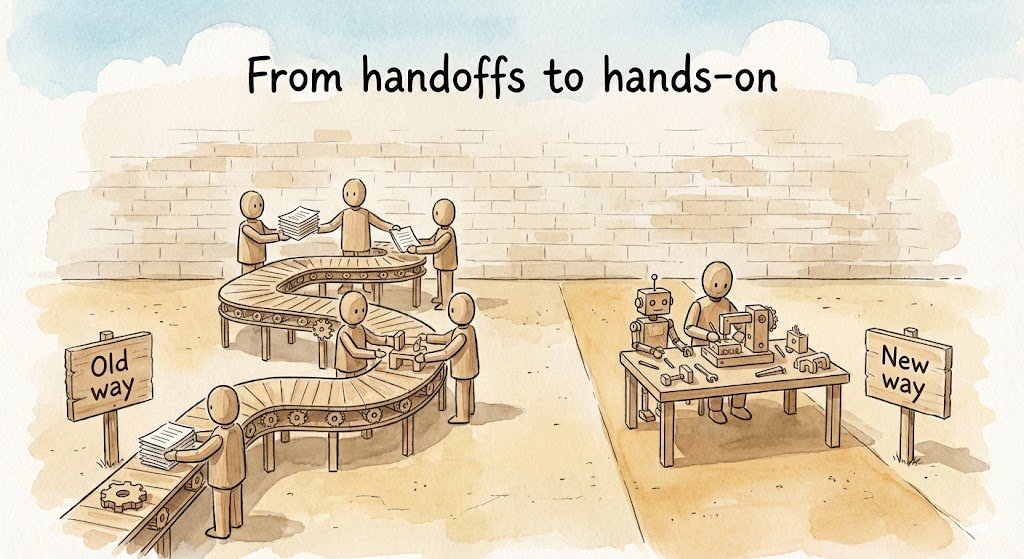
The fundamental workflow transformation looks like this:
Old model:
PM determines what to build → Writes specification → Engineers build → PM reviews → Iterate
New model:
PM determines what to build → PM builds with AI agents → PM evaluates → Rapid iteration → (When satisfied) Hand to engineers for production deployment
Modern AI product managers no longer merely hand off requirements. They personally create the first iteration and gather real feedback on working software—not slide decks or Figma mockups. Engineers then become collaborators focused on optimization and production-readiness rather than translators of intent.
This dramatically changes your relationship with the product. You’re not describing what you want and hoping it returns correctly—you’re directly shaping it in real-time.
Think in Iterations
Allow the first version to be wrong. Don’t attempt to perfect everything in your mind before starting. Provide the agent with rich problem context, then let it create a rough first attempt. Observe the output. React. Iterate. You’ll learn more from “this isn’t quite right because…” than from trying to anticipate every edge case upfront.
I regularly have agents build two or three completely different approaches to the same problem, simply to experience which solution feels most effective when used. What was once prohibitively expensive is now a Tuesday afternoon activity with parallel agents.
Embrace Ambiguity Longer
The traditional PM instinct was to resolve ambiguity into specifications as quickly as possible. The new instinct is to remain in the ambiguous space while exploring possibilities. Don’t prematurely commit to a single solution. Let agents help you understand the solution landscape before making final decisions.
Practical Guide: Adapting to the AI Agent Workflow
If you’re a product manager not yet working with AI agents in this capacity, here’s how to begin:
-
Start with a genuine small problem: Not a hypothetical one. Something actively frustrating you right now—a report you manually compile, a tedious workflow, a prototype you wish existed.
-
Invest 30 minutes in context preparation: Before writing any prompts, document the context using the framework outlined earlier.
-
Engage an agent and observe: Don’t expect perfection. Expect a starting point. React to the output. Guide subsequent iterations.
-
Repeat ten times: With different problems and varying complexity levels. You’ll develop intuition about what works, which context matters most, and how to evaluate outputs effectively. This intuition constitutes the new core PM skillset.
The product managers who will thrive are those who understand problems so deeply that the right solution becomes obvious—to both them and the AI agents they collaborate with.
I switch between AI Studio, Cursor, Antigravity, and Claude Code depending on the task. The specific tool matters less than building the daily muscle of working effectively with agents.
The Future-Proof Product Manager
If your role primarily involved translating customer needs into documents for engineers, you performed a workflow. Workflows get automated.
If your role centered on “understanding problems so deeply that the right solution becomes obvious,” you’re more valuable than ever. AI agents amplify that understanding into shipped products faster than any traditional team could achieve.
Every product manager should ask themselves: when the translation layer disappears, what remains?
For exceptional PMs, the answer encompasses everything that truly mattered all along:
-
Deep problem understanding -
Genuine user empathy -
Sound judgment -
Refined taste
These qualities were always part of product management. Now, they’re becoming the entirety of the role.
FAQ: Navigating the AI Product Management Transition
Will product managers be replaced by AI?
No. AI is automating specific PM tasks (documentation, basic requirement translation), not the entire role. As implementation barriers lower, the value of defining “what to build” actually increases. The best PMs will become more essential as they translate user needs into AI-executable intent.
Do I need to learn coding to survive in the AI era?
Not necessarily. You don’t need to become a coding expert, but understanding enough technical context to communicate effectively with AI agents is crucial. More importantly, develop skills in problem shaping, context curation, and critical evaluation. Understanding technical constraints and possibilities matters more than writing code yourself.
How do I start integrating AI agents into my workflow?
Begin small. Select a genuinely annoying repetitive task you face daily. Spend 30 minutes preparing context, then let an AI agent tackle it. Don’t expect perfection—view it as a learning process. After ten iterations, you’ll develop intuition about what works and what doesn’t.
Is AI-generated code reliable enough for production?
Reliability depends directly on context quality. Vague prompts yield vague results; specific context produces high-quality output. Treat AI-generated code as a starting point, not a final product. The optimal approach combines AI’s speed with human judgment—PMs and engineers collaborating to review, refine, and productionize these outputs.
How will the PM-engineer relationship evolve in the AI era?
The relationship is transforming from “requirements transmitter” to “solution co-creator.” PMs no longer merely write specifications and wait—they actively use AI tools to rapidly iterate solutions alongside engineers. Engineers shift from specification implementers to optimization specialists, ensuring AI-generated solutions are scalable, reliable, and secure. This creates a more collaborative, efficient product development process focused on value delivery rather than handoffs.