
GLM-Legal: Inside the Agentic Legal Model Built for Real Workflows
GLM-Legal is an agentic model for legal work. The point isn’t to answer a legal question in one turn. The point is to take fragmented source files, apply doctrine, build arguments, and produce a deliverable that meets a specific task brief.
According to the published information, GLM-Legal is built on the lightweight GLM-5.3-Flash foundation. It uses specialized mid-training and high-efficiency post-training. On Harvey LAB, it reaches a 19.2% all-pass rate, a 12.5 percentage point improvement over its base model. On LegalBench, it matches frontier closed-source models in accuracy while using a significantly leaner parameter budget. On PLawBench, it matches leading frontier systems on Chinese legal consultation, case analysis, and document drafting. It will soon be available in AutoClaw, the desktop-native agent platform.
This article breaks it down in four parts: the problem it solves, how to read the benchmarks, why the training method is different, and what it actually does in contract review, evidence analysis, and cross-border compliance.
What problem does GLM-Legal actually solve?
GLM-Legal targets the broken chain in legal work: facts, statutory doctrine, analytical reasoning, and client-ready work product. If any link fails, the output isn’t usable. Legal work concentrates these challenges, which makes it a strong stress test for models operating in high-stakes professional environments.
Legal practice demands an unbroken connection between what happened, what the law says, how the argument is built, and what the client receives. When an agent gets a professional task, it has to extract the core issues from source documents, build defensible arguments, and format its findings to exact task specifications. Satisfying all of those constraints at once is the real benchmark for a domain-specific model.
Real-world knowledge work adds two more pressures. Source files are fragmented, and delivery objectives are concrete. The model must digest those fragments under tight constraints, structure specialized knowledge into cohesive analysis, and maintain domain rigor across the full execution lifecycle.
My read: this is where single-turn legal Q&A often hides. A model can sound fluent in one answer. An end-to-end task is less forgiving. Miss one fact, misstate one citation, or drift from the required format, and a downstream team has to redo the work. GLM-Legal is positioned for the harder job: advancing a workflow under real constraints, not just offering general guidance.
How should you read the benchmark results? Harvey LAB, LegalBench, and PLawBench
The published evaluation covers three axes: complex task execution, specialized legal reasoning, and real-world legal workflows. GLM-Legal reached a 19.2% all-pass rate on Harvey LAB, matched frontier closed-source models on LegalBench, and matched leading frontier systems on PLawBench despite a leaner parameter footprint. Harvey Legal Agent Benchmark and LegalBench were independently evaluated by Vals.
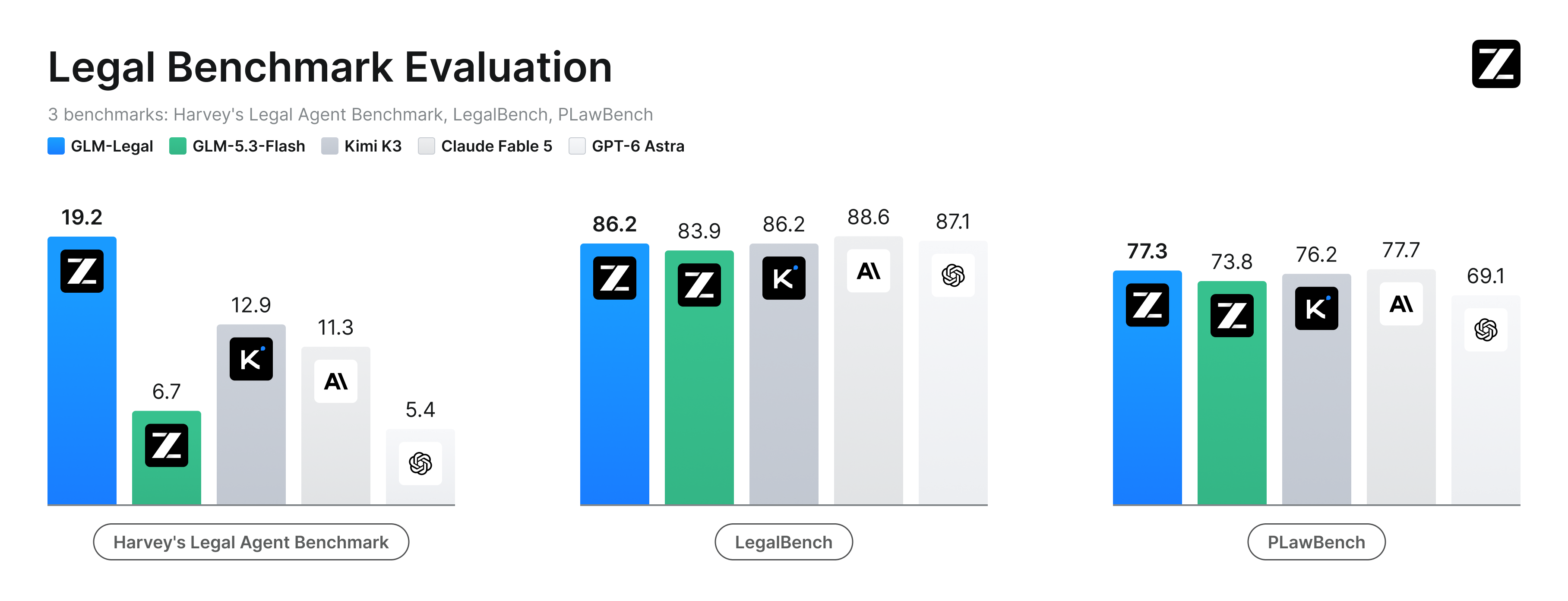
Harvey LAB: What does a 19.2% all-pass rate mean?
Harvey LAB tests real-world law firm workflows across 24 practice areas. Its grading is strict: all-pass means the task clears the bar end to end. GLM-Legal scores 19.2% and improves on its base model by 12.5 percentage points.
That number isn’t about one isolated skill. It points to reliable end-to-end task execution without intermediate degradation. A contract review task, for example, may require issue spotting, clause citation, proposed edits, and document generation. If any step fails, the final deliverable fails. Passing under an all-pass standard is harder than scoring well on a single sub-skill.
LegalBench: Fewer parameters, matching accuracy
LegalBench focuses on specialized legal reasoning. GLM-Legal parses specialized contracts, merger filings, and judicial opinions with the precision of top closed-source frontier models, despite operating on a significantly leaner parameter budget.
The important detail here is efficiency. The model isn’t buying accuracy by adding parameters. It’s using domain training and task-execution optimization on a lighter base. For teams thinking about deploying a legal agent, that affects inference cost and practical feasibility.
PLawBench: Chinese localized practice
PLawBench covers Chinese legal consultation, case analysis, and document drafting under fine-grained rubrics. GLM-Legal achieves parity with leading frontier systems.
Chinese legal practice has its own writing conventions, consultation patterns, and document formats. Matching leading systems on this benchmark suggests the model isn’t only effective on English-language material.
| Benchmark | What it covers | GLM-Legal result | Why it matters |
|---|---|---|---|
| Harvey LAB | Real law firm workflows across 24 practice areas | 19.2% all-pass rate | 12.5 percentage point gain over the base model; reliable end-to-end execution |
| LegalBench | Specialized contracts, merger filings, judicial opinions | Accuracy parity with top closed-source frontier models | Leaner parameter budget |
| PLawBench | Chinese legal consultation, case analysis, document drafting | Parity with leading frontier systems | Holds up under fine-grained rubrics |
What makes the training method different?
GLM-Legal prioritizes training efficiency. It is built on the lightweight GLM-5.3-Flash foundation and scales domain competence through specialized mid-training plus high-efficiency post-training. The design ties foundational pre-training directly to downstream task execution. The model is trained to parse source records, apply doctrine, structure arguments, and maintain output quality through final delivery.
That’s a different approach from “learn the law first, then figure out tasks later.” It puts knowledge and execution in the same loop.
Mid-training: Building the legal foundation
Mid-training establishes a systematic legal foundation. The team expanded the volume of high-quality legal corpora. The model learns legal concepts, statutory rules, and interpretive frameworks within dense domain context.
The goal isn’t just to memorize definitions. It’s to strengthen deductive connections between facts, rules, and conclusions. When the model reads a contract, it isn’t only matching keywords. It can place a clause inside a doctrinal framework and assess how it relates to the dispute, available remedies, and risk. That knowledge substrate is what complex downstream execution depends on.
Post-training: The model and the agent harness co-evolve
Post-training translates domain knowledge into task execution through reinforcement learning across tens of thousands of realistic legal environments. The model learns to plan analysis, advance workflows, and generate deliverables under concrete constraints.
In this setup, the harness is the runtime orchestration framework. It manages task context, connects toolsets, and routes execution feedback.
Harness architecture and model training iterate in lockstep. Task structuring, context ingestion, and runtime feedback loops collectively govern agent exploration. The learning is also bi-directional. Edge cases surfaced during model training pinpoint architectural bottlenecks in the harness. Harness refinements, in turn, expose the model to realistic execution constraints. The model learns to retrieve relevant context, adapt via intermediate execution signals, and meet production-grade standards from prompt ingestion to final sign-off.
My read: many teams treat the harness as glue outside the model. GLM-Legal treats it as part of training. Legal tasks depend heavily on context, tools, and delivery format. If you train the model but leave the runtime framework fixed, you often end up with a system that can analyze but can’t deliver.
Production feedback loops: Turning lawyer judgment into engineering signals
Real-world workflows and practitioner feedback set the optimization roadmap. In production, legal professionals evaluate outputs against concrete criteria:
-
Are all critical issues and edge cases addressed? -
Are arguments well-substantiated and citations legally sound? -
Does the deliverable strictly adhere to the matter brief? -
Can downstream teams use the output immediately without manual rework?
These requirements turn subjective quality into concrete engineering loss signals. When the team diagnoses issues such as missed facts, shallow analysis, or format deviations, it inspects the entire execution pipeline. It isolates the contributions of raw model intelligence, context staging, and workflow logic.
Those findings feed directly back into task environments, evaluation rubrics, and harness design for subsequent training cycles. Improvements are then validated against production benchmarks. This tight feedback loop between practical requirements, task environments, the harness, and model training is how algorithmic progress translates into production reliability.
What can it do inside AutoClaw? Three real tasks
AutoClaw is the desktop-native agent platform where these capabilities will be available. The published examples show GLM-Legal handling three common legal tasks: reviewing a contract, preparing a case, and planning a cross-border launch.
Contract review: Making the exit clause work for the client
Task: Review a software services contract for a client switching providers, focusing on termination and handover.
GLM-5.3-Flash
Termination and handover
The contract allows the client to terminate on 60 days’ notice and provides a 30-day cure period for material breaches. Consider shortening the notice period to give the client more flexibility. On termination, require the provider to return client data and completed deliverables for which the client has paid. Add a duty to cooperate with the replacement provider, including reasonable access to documentation and assistance with the handover. Confirm outstanding payments and any charges for transition support.
GLM-Legal
Termination and handover
Reduce the client’s convenience-termination notice from 60 to 30 days. Remove the cure period for breaches of IP, confidentiality, or data-security obligations so the client can terminate immediately. Section 4 already assigns the work product to the client: require return of all deliverables and work in progress, whether or not paid for. Add up to 90 days of transition assistance covering source code, documentation, data, and knowledge transfer to the client or its successor provider, at the provider’s then-current rates.
When changing providers, your team needs an exit clause that protects the handover.
GLM-Legal turns that goal into specific terms for immediate termination after serious breaches, return of work product, and up to 90 days of transition support. AutoClaw puts those edits into the Word document with tracked changes and comments, ready for your team to review and negotiate.
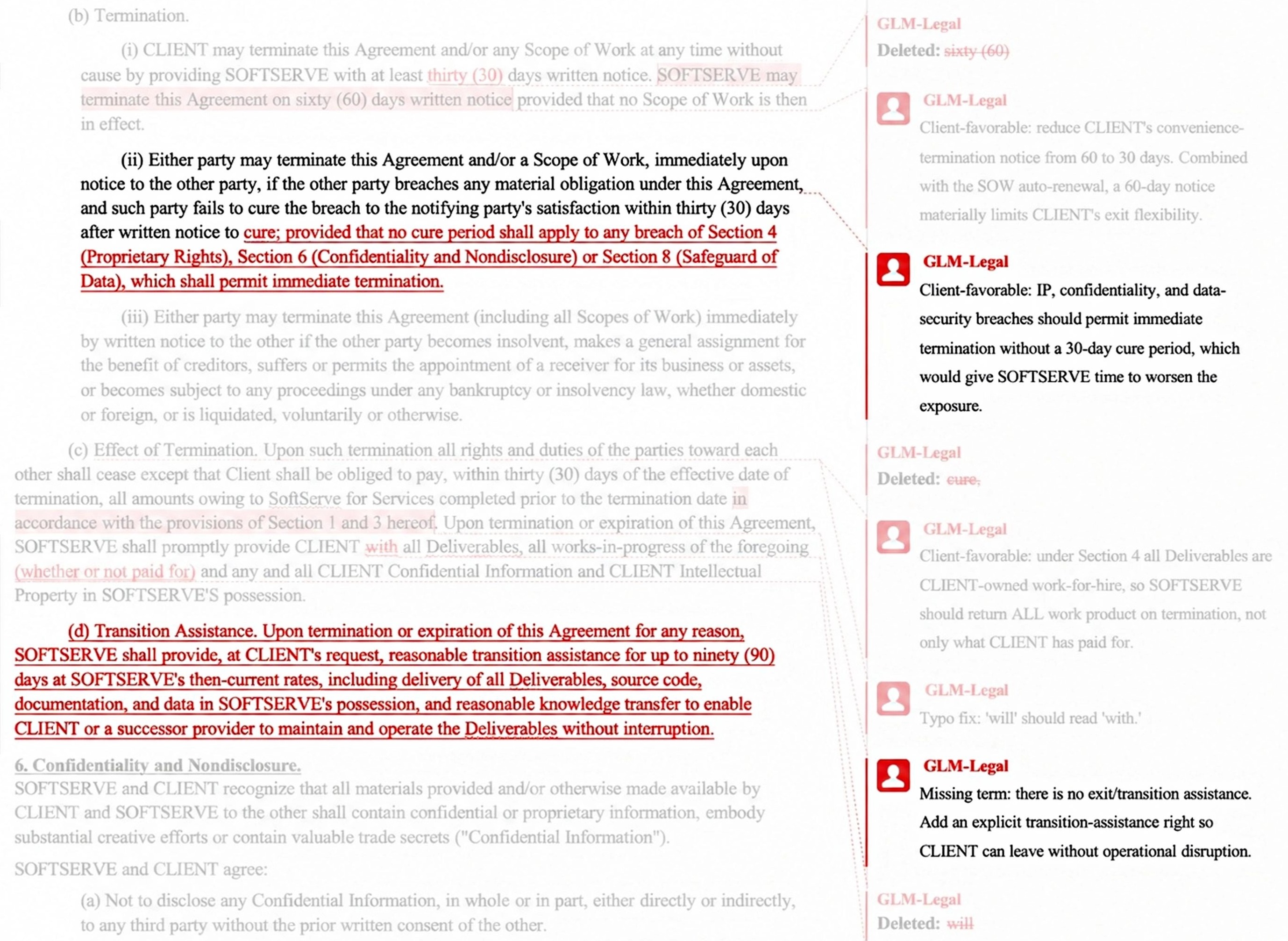
The difference is specificity. The base model says “shorten the notice period.” GLM-Legal says 30 days. The base model says “require return.” GLM-Legal addresses whether payment is required. The base model says “assist with handover.” GLM-Legal defines the scope, duration, and billing basis.
Evidence analysis: Connecting the documents to a case theory
Task: Analyze 40 documents from a software project dispute to identify contradictions in the provider’s progress reports.
GLM-5.3-Flash
External reports and internal records
The September 30 client report states that the project is on track and 60% complete (BR-000024), while the internal snapshot records approximately 41% completion (BR-000027). The internal emails also discuss architecture risks and instructions about client communications (BR-000014; BR-000015). These documents may support the client’s position that progress was overstated. Review the reporting history, invoicing records, and contract terms to determine whether the statements were misleading and what further evidence is needed.
GLM-Legal
External reports and internal records
The September 30 “ON TRACK – 60% COMPLETE” report (BR-000024) should be read against the September 8 warning that the milestone could not honestly be met (BR-000014) and the internal ~41% snapshot (BR-000027). The CEO’s instruction to suppress the risk and continue invoicing (BR-000015) links that internal knowledge to a disclosure decision. MSA §§2 and 5 state that payment does not waive rights and warranties survive payment (BR-000001), so continued payment alone does not resolve the dispute. These links support a concealment theory; reconcile the completion measures and test the remaining claim elements before drawing a final conclusion.
In a project dispute, the key is to connect the progress reports with what the provider knew internally.
GLM-Legal pairs external statements with conflicting records, cites the source documents, and explains their potential legal significance. The contradiction map helps your team assess the evidence and decide what to investigate next, while keeping facts and inferences distinct.
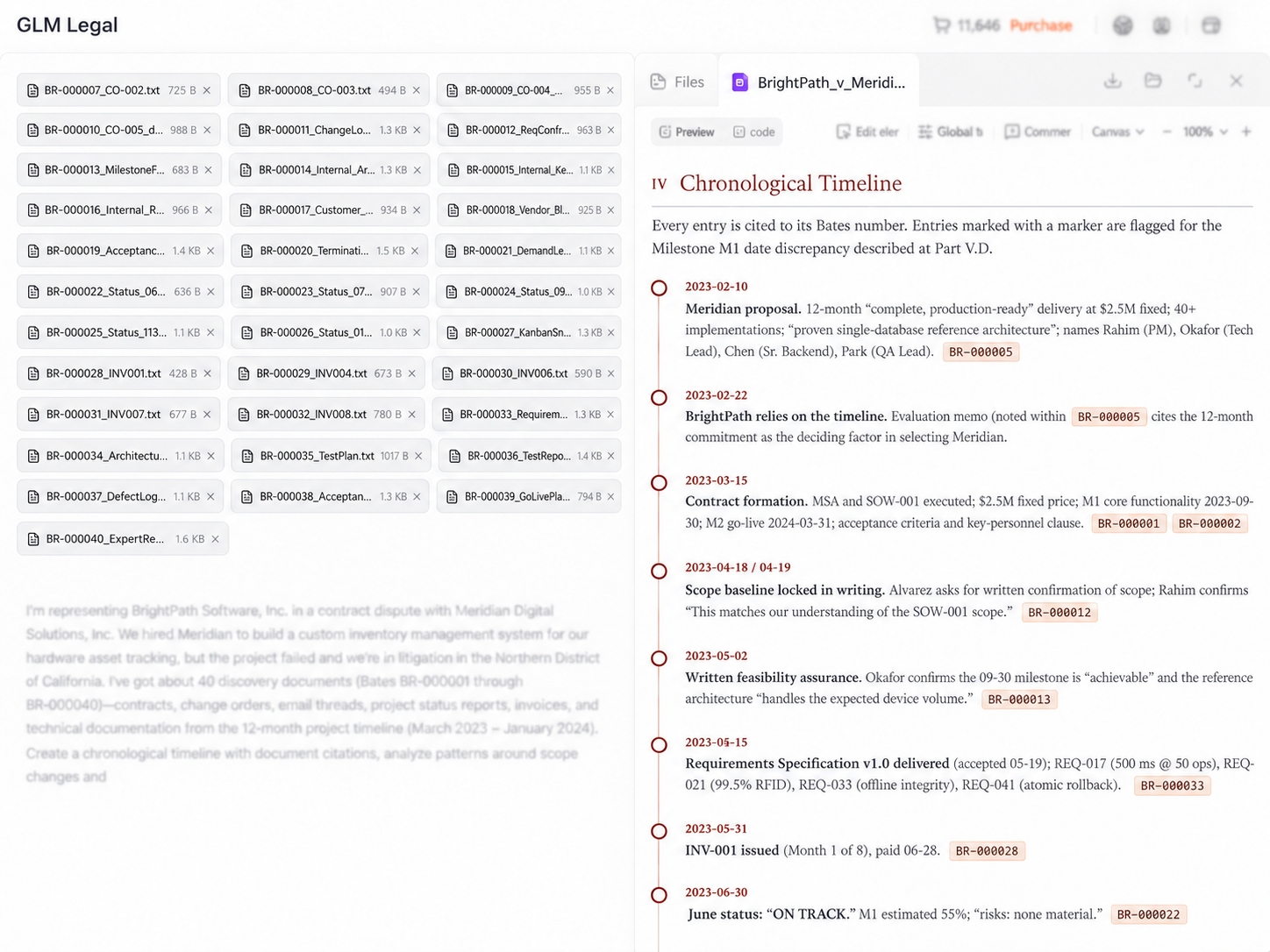
The important word here is “links.” Listing contradictions isn’t enough. The model has to explain why they matter legally. GLM-Legal brings external statements, internal records, and payment terms into one frame while separating facts from inferences. That gives the team a map for next steps instead of a premature conclusion.
Compliance research: Identifying pre-launch privacy priorities
Task: Plan privacy compliance for a website launching in Singapore, Malaysia, and Indonesia, with tracking, email marketing, and overseas cloud storage.
GLM-5.3-Flash
Pre-launch priorities
Before launch, publish a privacy notice explaining collection, use, sharing, and overseas storage. Review whether cookies and analytics need consent, include an unsubscribe option in marketing emails, and ensure vendors provide suitable data-protection safeguards. Check the applicable privacy laws in Singapore, Malaysia, and Indonesia and confirm any local requirements. The launch plan should address notices, consent, marketing, and transfers, with responsibilities assigned to the relevant teams and outstanding legal questions reviewed before the website goes live.
GLM-Legal
Pre-launch priorities
P0 — recommended before launch: Publish English and Indonesian privacy notices covering purposes, transfers, rights, and complaints. Use opt-in for non-essential analytics and advertising, keep consent records, and separate marketing permission from registration. Make unsubscribe requests feed a suppression list. Map cloud, payment, email, analytics, and CDN vendors to their data destinations, then confirm the contracts and transfer safeguards required in each market (SG PDPA s26; MY PDPA s129; ID PDP Law Arts 55–56). Use these shared controls as a conservative launch baseline, while checking each market’s specific requirements.
A cross-border launch needs a plan your team can act on.
GLM-Legal breaks privacy requirements into practical steps for tracking consent, marketing permissions, and overseas data transfers, with legal references for each market. The prioritised checklist helps your team implement shared controls and identify country-specific questions to confirm before launch.
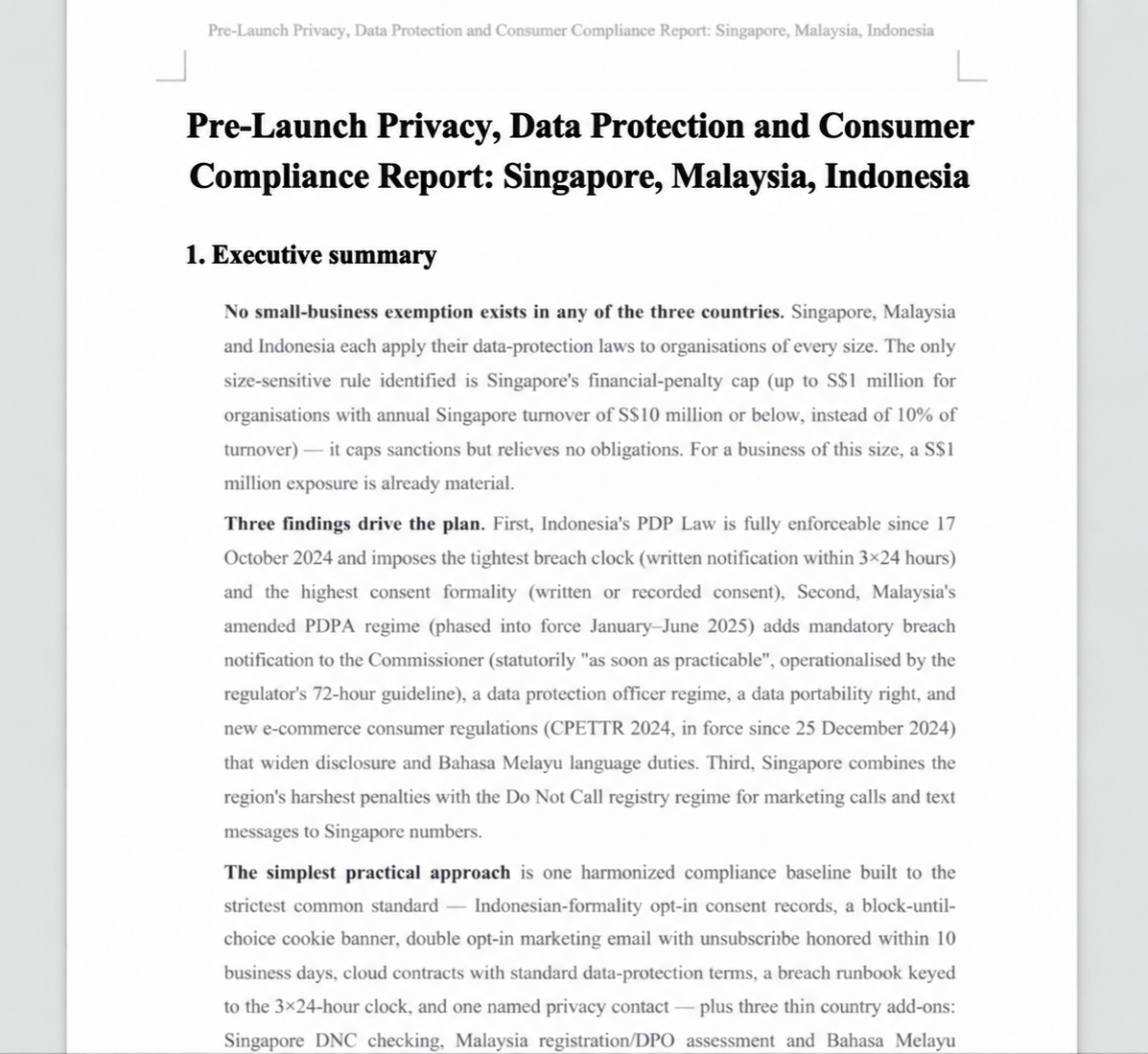
Cross-border compliance is easy to turn into a long list. Teams need to know what comes first. P0, opt-in, consent records, suppression lists, and vendor mapping are all actions that can be assigned and checked. The legal references give each control a source, which makes later confirmation with local counsel easier.
Who should join the GLM-Legal beta?
The beta is open to law firms, legal tech companies, in-house legal teams, and independent practitioners. The published invitation names those four groups directly. Entry points include consultation and AutoClaw.
For a law firm, GLM-Legal can fit into contract review and case preparation. For a legal tech company, it can serve as the task-execution layer inside a product. For an in-house team, it is relevant to cross-border compliance and vendor contracts. For an independent practitioner, it looks more like a workflow assistant than a chat window that only gives general answers.


Practical summary and action checklist
If you remember one thing, make it this: GLM-Legal’s focus isn’t “knowing law” in the abstract. It’s turning legal knowledge into end-to-end task execution. The benchmarks, training method, and examples all point to that.
-
Benchmarks to watch: Harvey LAB at 19.2% all-pass, a 12.5 percentage point gain over the base model; LegalBench accuracy parity with closed-source frontier models on a leaner parameter budget; PLawBench parity on Chinese legal practice. Harvey LAB and LegalBench were independently evaluated by Vals. -
Training in three stages: Mid-training expands high-quality legal corpora and strengthens fact-rule-conclusion deduction. Post-training runs reinforcement learning across tens of thousands of realistic legal environments, with model and harness iterating together. Production feedback turns lawyer evaluation into engineering loss signals. -
Contract review checklist: Termination notice period, whether the cure period is removed, whether return of work product depends on payment, and the scope and billing of transition assistance. -
Evidence analysis checklist: External reports versus internal records, whether internal knowledge affected disclosure decisions, and whether payment terms waive rights or let warranties survive. -
Compliance checklist: Notice languages, opt-in, consent records, suppression list, vendor data-destination mapping, and required contracts and transfer safeguards in each market. -
Delivery inside AutoClaw: Edits can be placed into Word with tracked changes and comments for review and negotiation. -
Beta audience: Law firms, legal tech companies, in-house legal teams, and independent practitioners.
One-page overview
| Dimension | Key detail |
|---|---|
| Model positioning | Agentic model for legal work, focused on end-to-end task execution |
| Foundation | Lightweight GLM-5.3-Flash |
| Harvey LAB | 19.2% all-pass rate, 12.5 percentage point gain over base model, 24 practice areas |
| LegalBench | Accuracy parity with top closed-source frontier models, leaner parameter budget |
| PLawBench | Parity with leading frontier systems on Chinese consultation, case analysis, drafting |
| Independent evaluation | Harvey Legal Agent Benchmark and LegalBench independently evaluated by Vals |
| Training method | Mid-training builds legal foundations; post-training uses reinforcement learning in tens of thousands of realistic legal environments |
| Harness | Runtime orchestration framework managing context, tools, and feedback; co-evolves with the model |
| Production feedback | Evaluates issue coverage, edge cases, argument and citation quality, matter brief adherence, and downstream usability |
| AutoClaw | Desktop-native agent platform for contract review, case preparation, and cross-border launch planning |
| Beta audience | Law firms, legal tech companies, in-house legal teams, independent practitioners |
FAQ: Eight questions readers are likely to ask
What foundation is GLM-Legal built on?
It is built on the lightweight GLM-5.3-Flash foundation.
What is its Harvey LAB score?
It reaches a 19.2% all-pass rate, a 12.5 percentage point improvement over its base model.
How does it compare with closed-source frontier models?
On LegalBench, it matches top closed-source frontier models in accuracy while using a significantly leaner parameter budget. On PLawBench, it matches leading frontier systems on Chinese legal practice.
Who evaluated the benchmarks?
Harvey Legal Agent Benchmark and LegalBench were independently evaluated by Vals.
How does post-training work?
It uses reinforcement learning across tens of thousands of realistic legal environments. The model and the agent harness iterate together.
What does production feedback evaluate?
Whether critical issues and edge cases are addressed, whether arguments and citations are sound, whether the deliverable follows the matter brief, and whether downstream teams can use it without manual rework.
What can AutoClaw do?
It is a desktop-native agent platform. The published examples cover contract review, case preparation, and cross-border launch planning.
Who can join the beta?
Law firms, legal tech companies, in-house legal teams, and independent practitioners.